
The Role of Digital Identity (e-KYC) in Expanding Microfinance Access: Contribution to SDG 10 and SDG 16
Article Sidebar
Main Article Content
Abstract
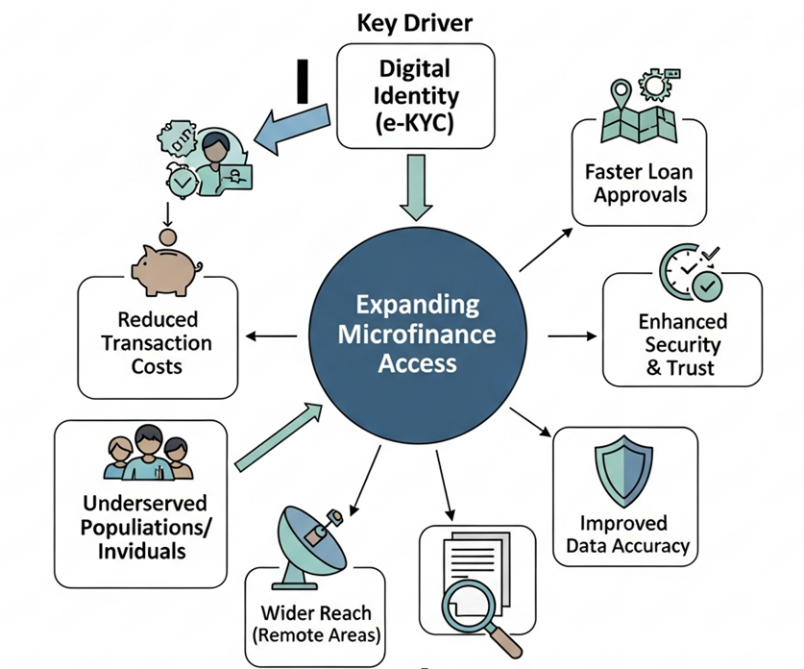
This paper discusses how digital identity systems and specifically the electronic Know Your Customer (e-KYC) can be used to increase access to microfinance and support SDG 10 (Reduced Inequalities) and SDG 16 (Peace, Justice, and Strong Institutions). Regardless of the rise of digital finance, they still discriminate against the marginalized groups based on restrictive identity verification procedures, high onboarding fees, and low institutional trust. The fundamental issue dealt with in this study is the existing identity barrier, which restricts the reach of microfinance to the informal workers, rural families, and those with low-income businesses and enterprises. The literature review indicates that there is an identified gap of critical importance where empirical research has not been done to establish the relationship between e-KYC adoption and inequality reduction outcomes and institutional efficiency in the microfinance ecosystems. To close this gap, the study will use a mixed-method approach that integrates logistic regression analysis that can measure changes in probability of accessing the loan, difference-in-differences estimation that will measure pre- and post-implementation of e-KYC effects, and process efficiency analysis that will measure compliance cost and time saving in reaction to verification. The results of the panel data analysis, which included 380 microfinance institutions and 1,200 borrowers, suggest that the implementation of e-KYC had a positive impact on the first-time borrower inclusion rate (34.7) and a shorter customer onboarding time (62.3) and lower verification costs (41.5), which directly address SDG 10 goals on financial inclusion. Also, better identity verification increased institutional transparency and prevented fraud, and fraud involving identity became less frequent (by 28.9 percent), which supports SDG 16 goals. The impact of the study is in the ability to present the quantifiable evidence that digital identity infrastructure enhances equitable access to finance and increases governance efficiency. The results underscore the importance of e-KYC as a policy tool that can be used to scale up microfinance growth in inclusive microfinance development and institutional trust building in developing economies.