
Industry 4.0 for Small Enterprises: Cloud-to-Edge Transformation and Its Impact on Productivity and Employment in Emerging Economies
Article Sidebar
Main Article Content
Abstract
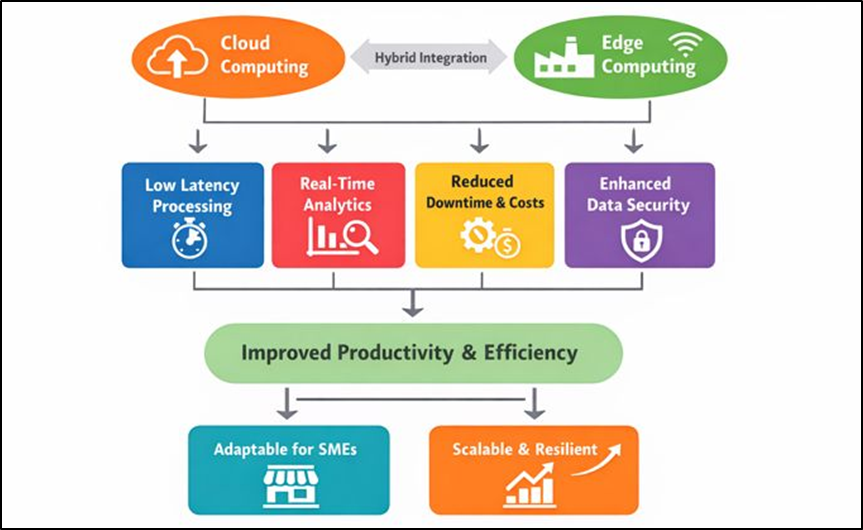
This paper analyses how small and medium-sized enterprises (SME) in the emerging economies are adopting Industry 4.0 with specific reference to cloud-to-edge transformation and its potential impact on productivity and employment. Although the use of new digital technologies has become common among large ventures, SMEs are usually constrained due to cost, capacity, infrastructures, and data management. The article builds a conceptual cloud-to-edge Industry 4.0 system that combines IoT-enabled systems, edge and fog nodes, and scalable cloud servers to aid in real-time analytics, automation, and data-driven decision-making under resource-limited conditions. The survey evidence, secondary datasets, and example case studies of manufacturing, service, and agro-industrial SMEs are mixed with the survey evidence in the study using the mixed-method research design. The effects of productivity are measured in terms of operation efficiency, decreased downtime, quality, and responsiveness of the supply chain, whereas the effects of employment are measured regarding creation of jobs, change in tasks, intensity of skill, and productivity of labour. The results show that the cloud-to-edge architectures contribute to much better visibility of the processes and predictive maintenance as well as latency reduction in comparison to cloud-only systems, which translate to productivity gains. The impact on employment is less obvious: there is a tendency to replace routine tasks with robots, but there are new jobs in the field of supervising systems, data processing and management, and high demand for reskilling. The paper identifies policy, infrastructure, and capability-building issues that should be in place to result in inclusive digital transformation.