Decentralised Local Governance, Political Influence and MSME Development in Indonesia
Article Sidebar
Main Article Content
Abstract
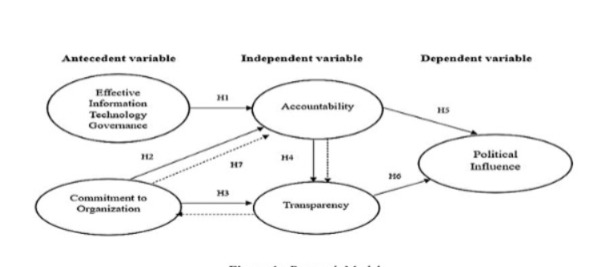
The paper explores the interaction between information technology governance, organizational commitment, accountability, transparency, and political influence in the Indonesian decentralised local government, and specifically with respect to MSME-supportive governance functions. Using a cross-sectional survey design, a sample of 302 public servants, heads, senior and junior accounting officers dealing with financial management and local development programs in the district governments was used to collect the data. The proposed relationships and the mediating effects were tested with the help of Partial Least Squares Structural Equation Modelling (PLS-SEM). The findings show that information technology governance positively contributes towards accountability (β = 0.305, p = 0.000), whereas organizational commitment has a positive effect on both accountability (β = 0.253, p = 0.000) and transparency (β= 0.436, p = 0.000). The transparency, in its turn, is positively correlated with accountability (β =0.323, p < 0.000) and mediates the correlation between organizational commitment and transparency (β =0.134, p = 0.002). Nevertheless, accountability does not have a significant impact on political interference (β = -0.093, p = 0.134). Conversely, transparency has a conclusive effect of limiting political influence with a strong negative influence (β =0.413, p < 0.000). The results are used to understand the concept of decentralised governance and local political economy in Indonesia, especially using the coercive isomorphism. Formal accountability mechanisms are also needed but not enough to curb the political interference in MSME-related policymaking and resource distribution. Transparency that is facilitated by digital governance, open data and access to information by the public turns out to be a more impactful tool that could be utilized to increase institutional legitimacy and protect the MSME development programmes against being politically captured. In its analysis of the essence of decentralisation in the local economic development, the study emphasises the significance of incorporating transparent reporting and participatory governance practices to facilitate inclusive, accountable and sustainable economic development in the local economy. The paper emphasizes the need to combine transparent reporting frameworks and participatory forms of governance with the aim of enhancing inclusive, accountable, and sustainable local economic development within the decentralised framework.
Article Details

This work is licensed under a Creative Commons Attribution-NoDerivatives 4.0 International License.