Women’s entrepreneurial intentions in transitional economies: The dual role of entrepreneurial self efficacy under social barriers
Article Sidebar
Main Article Content
Abstract
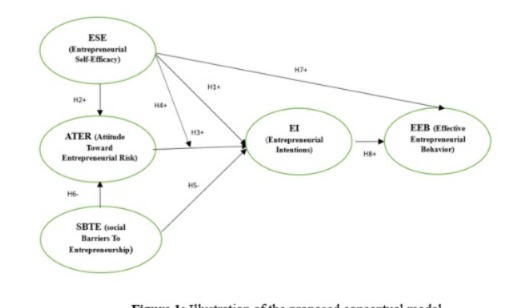
This study investigates how cognitive and contextual factors influence women's entrepreneurial intention (EI) in transition economies. Based on the Theory of Planned Behavior (TPB) and the Social Cognitive Theory (SCT), the model examines the predictive role of Entrepreneurial Self-Efficacy (ESE), Attitude Toward Entrepreneurial Risk (ATER), and Social Barriers to Entrepreneurship (SBTE) on entrepreneurial intention (EI) and subsequently Effective Entrepreneurial Behavior (EEB). Using a structural equation model on survey data from 658 Vietnamese women, the study shows that all three predictive factor-ATER, EEB, and SBTE-significantly influence EI. Notably, Entrepreneurial Self-Efficacy (ESE) moderates the relationship between ATER and EI, so that the positive impact of risk attitude on intention is amplified when ESE is high. Furthermore, ESE is a direct predictor of Effective Entrepreneurial Behavior (EEB). This research contributes to entrepreneurship research by clarifying the conditional role of ESE and affirming that strengthening both expectation and confidence can help overcome risk- and social barriers to entrepreneurship for women in a transitional context.