AI-Driven Predictive Modeling for Sustainable Urban Water Resource Management and Flood Risk Assessment
Article Sidebar
Main Article Content
Abstract
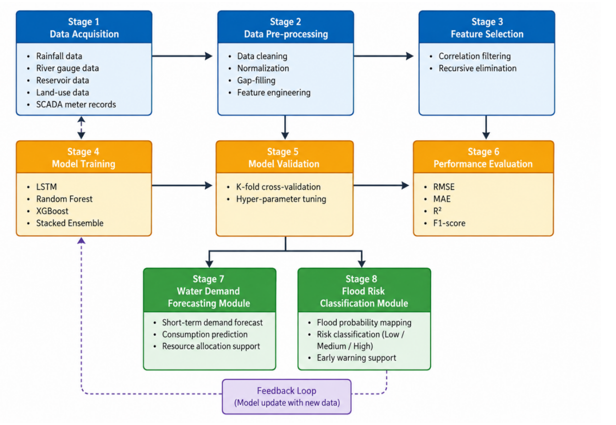
Rapid urbanization, aging distribution infrastructure, and increasingly erratic rainfall patterns have placed municipal water systems under mounting strain, exposing cities to the simultaneous risks of supply shortage and pluvial flooding. This paper presents an integrated artificial-intelligence framework that couples short-term water demand forecasting with spatial flood risk classification within a single analytical pipeline. Historical consumption records, hydrometeorological variables, and land-cover indicators were combined and processed through an ensemble of Long Short-Term Memory networks, Random Forest regressors, and Extreme Gradient Boosting classifiers. The stacked ensemble achieved a coefficient of determination of 0.93 for demand prediction and a classification accuracy of 91.4 percent for flood risk zoning, outperforming individually tuned baseline models across every evaluation metric. Results indicate that antecedent rainfall, river gauge elevation, and impervious surface coverage are the dominant predictors of urban flood susceptibility, while historical demand lag and seasonal temperature govern consumption variability. The proposed framework offers municipal planners a computationally efficient, data-driven instrument for anticipating both water scarcity and inundation events, thereby supporting proactive infrastructure investment and emergency preparedness under climate uncertainty.
Article Details

This work is licensed under a Creative Commons Attribution-NonCommercial-ShareAlike 4.0 International License.