Development of an Intelligent Decision-Support Model for Feedstock Selection and Carbon-Credit Maximization in Multi-Feedstock Bio- Plants
Article Sidebar
Main Article Content
Abstract
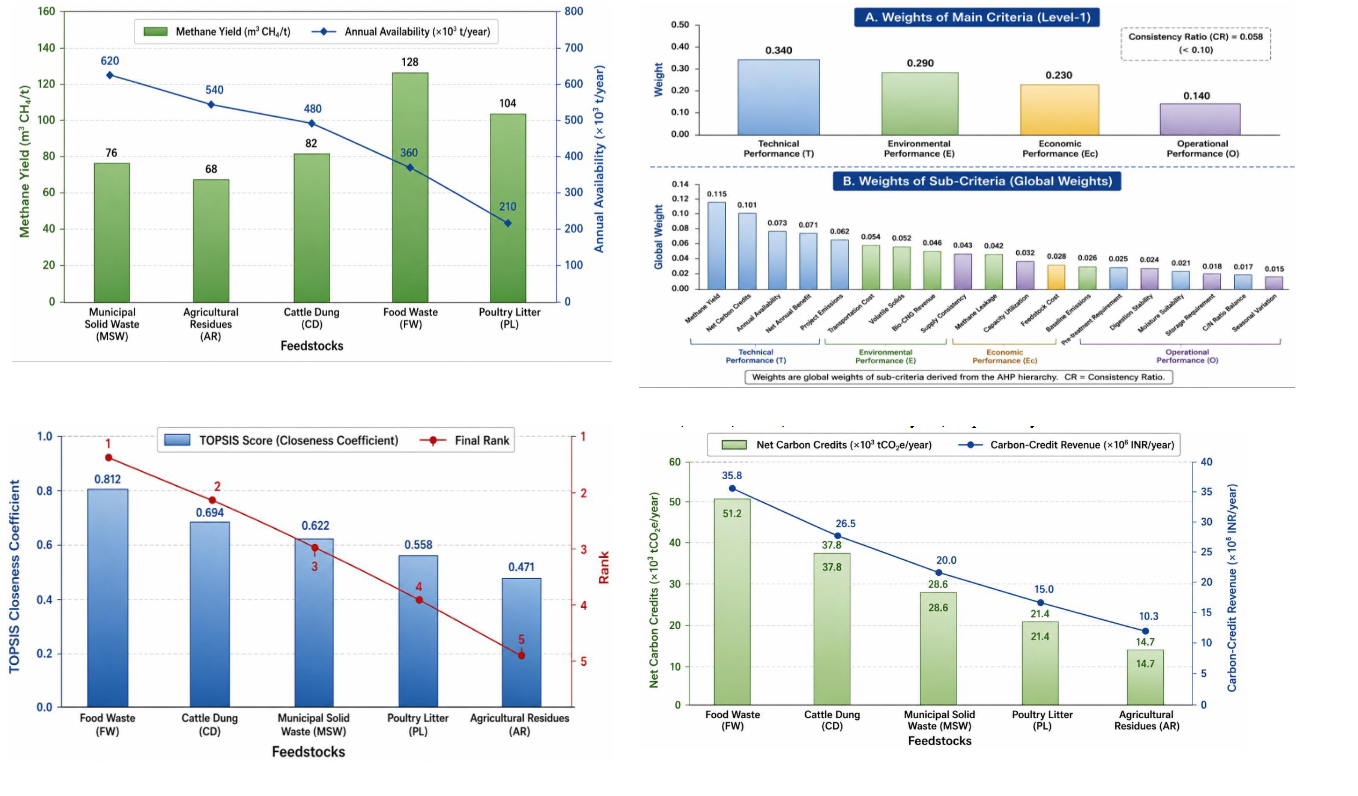
The selection of suitable feedstocks is essential for achieving stable Bio-CNG production, effective plant-capacity utilization, greenhouse-gas mitigation, and carbon-credit revenue. This study developed an intelligent decision-support model for selecting individual feedstocks and optimizing feedstock blends for multi-feedstock Bio-CNG plants. Municipal solid waste, agricultural residues, cattle dung, food waste, and poultry litter were evaluated using technical, environmental, economic, and operational criteria. The Analytic Hierarchy Process was employed to determine criterion weights, while the Technique for Order Preference by Similarity to Ideal Solution was used to rank the alternatives. Technical, environmental, economic, and operational criteria received respective weights of 0.34, 0.29, 0.23, and 0.14. Among the individual criteria, methane yield, net carbon-credit potential, annual availability, net annual benefit, and project emissions had the greatest influence on feedstock selection. Food waste achieved the highest individual-feedstock closeness coefficient of 0.812, followed by cattle dung, municipal solid waste, poultry litter, and agricultural residues. Five multi-feedstock combinations were subsequently evaluated. The optimized blend containing 35% food waste, 30% cattle dung, 20% municipal solid waste, 10% agricultural residues, and 5% poultry litter achieved the highest decision score of 0.876. It produced an estimated 3.22 million m³ of Bio-CNG annually, generated 35,160 tCO₂e of net carbon credits, attained 95.2% plant-capacity utilization, and provided a net annual benefit of ₹14.18 crore. Sensitivity analysis showed that methane yield and feedstock availability were the most influential parameters, while the optimized blend retained the first rank under all evaluated scenarios. The proposed model provides a transparent and adaptable framework for feedstock procurement, blending, carbon-credit planning, and operational decision-making in commercial Bio-CNG plants.
Article Details

This work is licensed under a Creative Commons Attribution-NonCommercial-ShareAlike 4.0 International License.