Mechanical Design Optimization of Sedimentation and Filtration Units for Energy Efficient Water Treatment Systems
Article Sidebar
Main Article Content
Abstract
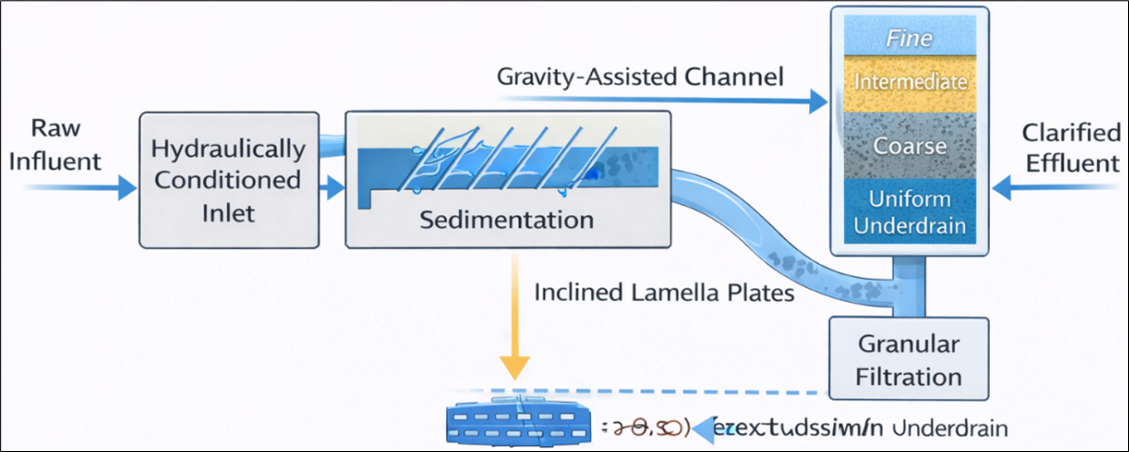
The fact that water treatment usually consumes a lot of energy is an issue of operations as well as of environmental concern especially in the fields of sedimentation and filtration which determine the solid-liquid interactions as well as hydraulic resistance. A complete mechanical design optimization concept is established in order to optimize the efficiency of the treatment process and reduce the head loss and specific energy requirements through the joint redesign of clarifier geometry, lamella settling pattern, and graded porous-media filtration. Calculation of hydraulic and transport principles are accompanied by computational fluid dynamics assessment, multi-objective optimization, in order to determine the energy-efficient design parameters. A prototype laboratory scale is built to confirm the performance predicted at controlled flow and turbidity. Alterations of the placing results of experiments show higher turbidity removal; longer filtration run time; reduced clogging behavior; greater hydraulic head loss reduction and energy usage reduction compared with a conventional baseline arrangement. Between-simulation and experimental findings also indicate that the suggested optimization approach can be reliably applied and that the development of a combined filtering and sedimentation approach should be presented within a common hydraulic framework. The invented solution offers a viable framework of water treatment infrastructure attainment, which is scalable to low-energy and sustainable water management in both decentralized and centralized systems.
Article Details

This work is licensed under a Creative Commons Attribution-ShareAlike 4.0 International License.