Adsorptive Removal of Heavy Metals from Wastewater Using Bamboo and Coconut Biochar: A Modelling Approach
Article Sidebar
Main Article Content
Abstract
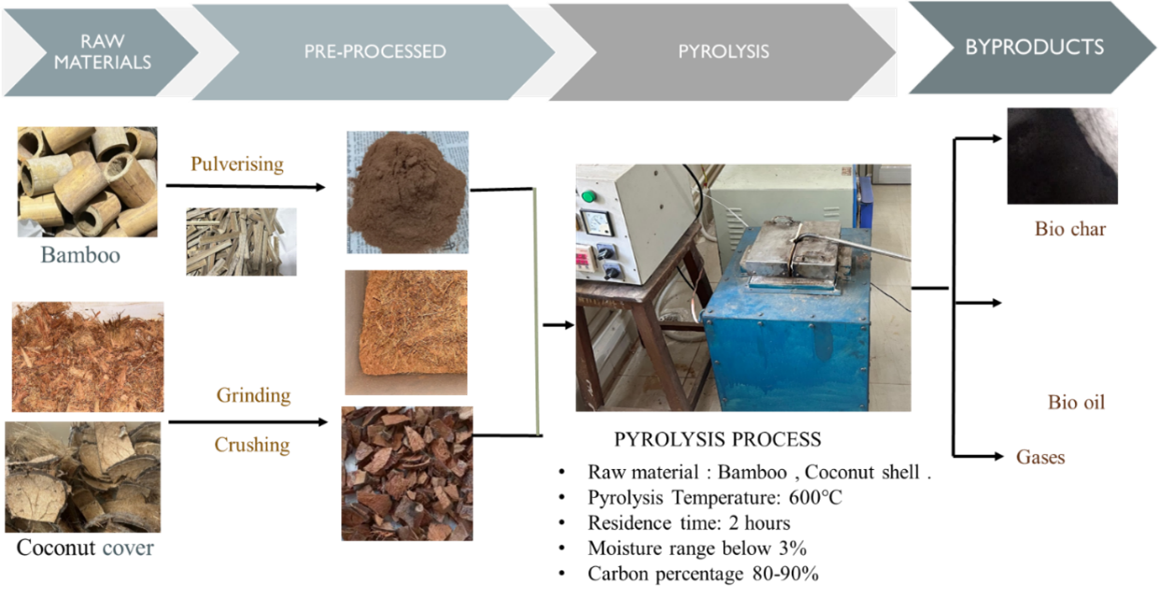
Heavy metal persistence in aquatic systems continues to threaten ecological stability and public health, particularly where centralized treatment is limited. In this context, adsorption using waste derived carbon materials offers a technically viable and circular approach. This study evaluates coconut shell and bamboo derived biochar as low-cost adsorbents for copper (Cu²⁺) and lead (Pb²⁺) removal linking surface functionality with adsorption performance. Biochar was synthesized via slow pyrolysis and characterized for morphology, porosity, surface charge and functional groups that govern metal binding. Batch experiments assessed the effects of pH, dosage, contact time and initial concentration. Adsorption was strongly pH-dependent, with optimal uptake at pH 5-7. Rapid kinetics were observed, with equilibrium achieved at 60 min for Cu²⁺ and 45 min for Pb²⁺. Isotherm analysis indicated distinct mechanisms. Cu²⁺ adsorption onto coconut shell biochar followed the Langmuir model (qmax = 102.67 mg/g, R² = 0.99), achieving 99.32% removal and suggesting monolayer coverage. In contrast, Pb²⁺ adsorption onto bamboo biochar followed the Freundlich model (n = 3.29, R² = 0.981) with 98.92% removal, indicating heterogeneous multilayer adsorption. Kinetics for both metals conformed to the pseudo-second-order model, implying chemisorption-dominated interactions. FTIR and zeta potential analyses confirmed the role of oxygen containing functional groups and surface charge in metal uptake. Beyond performance, this biochar integrates waste valorisation with water treatment, supporting low-energy, decentralized applications. Their effectiveness, coupled with feedstock-driven surface variability, underscores the need for a systems-oriented approach that considers adsorption efficiency alongside material lifecycle and environmental sustainability.
Article Details

This work is licensed under a Creative Commons Attribution-ShareAlike 4.0 International License.