IoT-Enabled Real-Time Water Quality Surveillance and Decision Support Systems for Sustainable Rural WASH Infrastructure Management
Article Sidebar
Main Article Content
Abstract
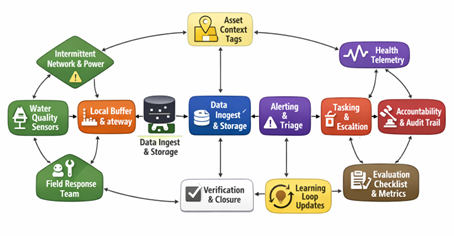
Rural drinking-water services increasingly use continuous monitoring, yet many deployments stop at dashboards and do not lead to feasible operations and maintenance actions. A key gap, in the evaluated setting, is the absence of an end-to-end specification that connects near-real-time water-quality signals to accountable decision owners, action owners, and closure evidence under intermittent connectivity and sensor drift. To address this gap, a decision-first conceptual framework is presented that organizes an IoT-enabled stack from monitoring objectives through sensing, transfer, data assurance, interpretation, alerting, tasking, escalation, verification, closure, and a learning loop. The framework is anchored to 3-5 recurring decision archetypes and defines minimum signals, quality assurance and quality control gates, tiered alert severity, and audit-ready workflow records. It also provides an evaluation checklist that separates monitoring-only deployments from decision support, with particular attention to common failure modes that prevent alerts from translating into owned actions and verifiable closure. Health impacts are not claimed without outcome evaluation. In practical settings, the approach can guide the design and audit of rural WASH management systems for real-world use by service managers and implementers.
Article Details

This work is licensed under a Creative Commons Attribution-ShareAlike 4.0 International License.