Bridging Research and Practice: Advancing Urban Water Protection Through Interdisciplinary Engineering Innovation
Article Sidebar
Main Article Content
Abstract
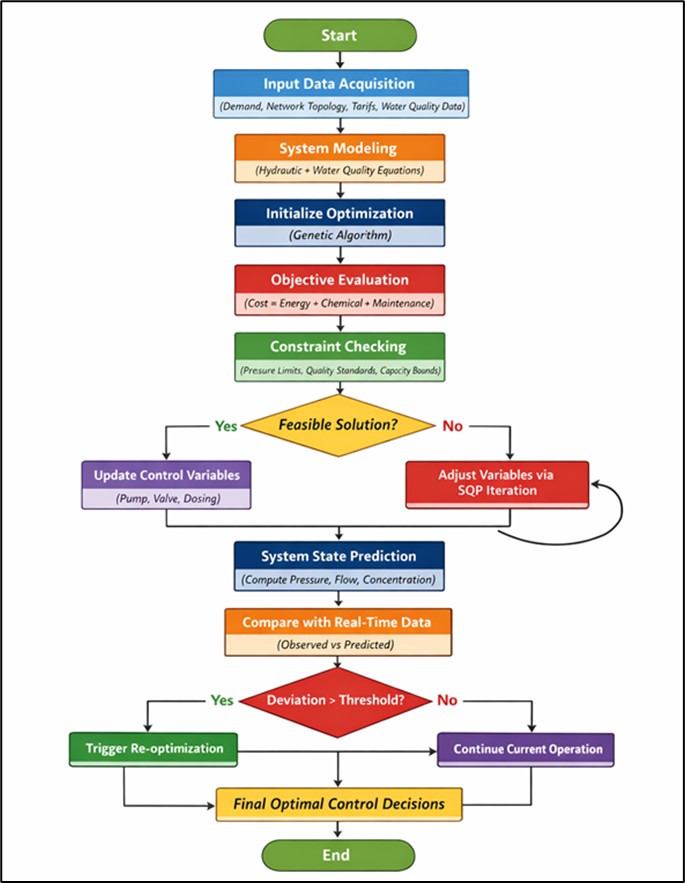
Rapid urbanization has increased pressure on freshwater resources resulting in inherent vulnerabilities of traditional approaches to water protection which are deeply disciplinary and cannot meet the multifaceted, dynamic character of contemporary urban water systems. The paper introduces an interdisciplinary engineering model of advancing the protection of urban water that involves the harmonious incorporation of civil, environmental, chemical, and data engineering disciplines through the use of technologies into one technological solution. The offered system architecture is proposed to integrate Internet of Things (IoT)-based real-time sensing networks with artificial intelligence and machine learning (AI/ML)-based predictive models and a digital twin model of the urban water infrastructures, forming a cyber-physical platform that can be used in terms of continuous monitoring, early anomaly detection, and efficient management of the resources. Contamination of urban water sources by industrial effluents, domestic wastewater and stormwater runoffs are solved using mathematically constructed pollutant transport models, sensor data fusion algorithms, multi-objective optimization schemes, and the resilience-based risk assessment schemes. An urban case study simulation that illustrates two different metropolitan conditions shows that the integrated framework can detect pollutants with an accuracy of 96.7 percent and it can cut the average system response time of 420 seconds to 18 seconds and minimise the annual operational costs of the system by 58.8 percent, relative to the traditional monitoring methodologies. Environmental impacts have had a minimum environmental impact of 62.1 reduction in the associated carbon emissions and a minimum of 77.2 decrease in the treated water losses. The findings confirm the soundness, generalizability as well as applicability of the framework in a heterogeneous urban setting, to offer practical engineering principles to researchers, practitioners as well as policymakers who aim to bridge the ever-present gap between water-management research and practical field implementations.
Article Details

This work is licensed under a Creative Commons Attribution-NonCommercial-ShareAlike 4.0 International License.