Enhancing Water Security through Hybrid Rainwater Harvesting and Storage Infrastructures
Article Sidebar
Main Article Content
Abstract
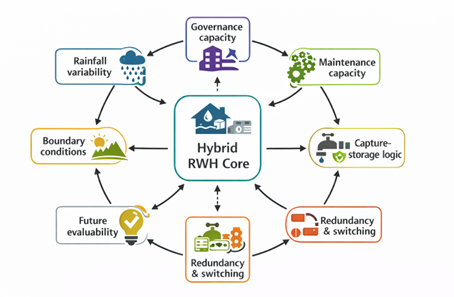
Rainwater harvesting and storage are widely used in WASH, unfortunately design guidance often treats them as separate parts. This creates an issue in explaining how combined capture and storage options affect water security under different climate, governance, and maintenance capacity conditions. This article provides a practice-oriented conceptual framework that defines water security as availability, reliability, quality protection, access continuity, and maintainability. It then links design logic on redundancy and switching between sources to the pathways that explain how these choices work, with clear boundary conditions. The framework is tested using contrasting illustrative scenarios. It also sets out a path for future evaluation, with candidate metrics, propositions, and implementation questions. The main contribution is a decision logic that can be checked and rebuilt from its steps. It avoids site-specific performance claims and may inform safer real-world use by engineers, NGOs, and policy makers planning rainwater-dependent services.
Article Details

This work is licensed under a Creative Commons Attribution-ShareAlike 4.0 International License.